
Reflection
Conflict and Repair: What It Really Looks Like
Sometimes resentment starts with something we have clearly asked for being ignored. And sometimes it starts much more quietly, with a hope that turns into an expectation without the other person ever knowing.
When hope becomes expectation
My partner and I have a simple arrangement. I normally cook Monday to Thursday, and he cooks Friday to Sunday. Sometimes, if I am busy, he notices and cooks instead.
One evening, a friend called just before dinner. I answered, and we ended up talking for about an hour. Somewhere during that call I thought, Maybe he’ll cook. He had done it before.
By the time I finished, it was around 8 p.m. He had not started dinner, and I could feel myself getting annoyed. I went into the kitchen and started making something quickly whilst holding quite a bit of resentment.
He noticed and asked what was wrong. “I’m cooking dinner,” I said. Angry cooking, admittedly. Then I asked, with some charge, “You noticed I wasn’t cooking. Why didn’t you cook?”
“Because I was busy too,” he replied.
Ah. That was the information I did not have. I had never asked whether he was available. Somewhere along the way, maybe he’ll cook had quietly become why hasn’t he cooked?
How the cycle forms
When dinner was ready, he came in, sat on the sofa and started looking at his phone. At that point I snapped. Now there was something concrete I genuinely was annoyed about. I wanted him to help with the table, but that moment was also carrying all the resentment that had already built.

He became defensive. “I can’t do anything right.”
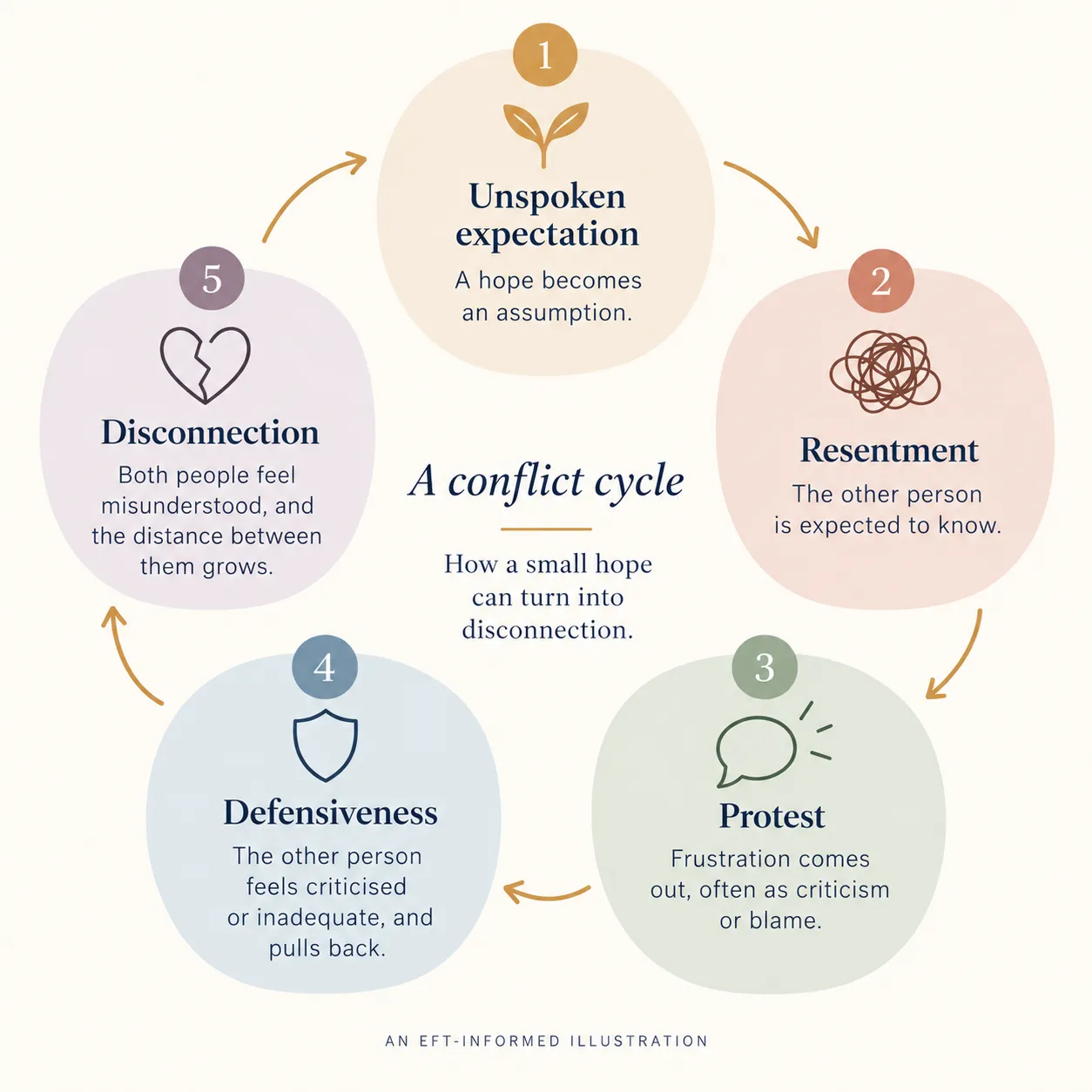
It would have been easy to decide that one of us was the problem. I was too reactive. He was inconsiderate. But that misses the cycle. I hoped he would cook, I did not ask, hope became expectation, then resentment. He knew something was wrong but not why. Then he sat down with his phone, I snapped, and he became defensive.
Emotionally Focused Therapy pays attention to these interactional cycles and how each person’s response shapes what happens next. I find What happened between us? much more useful than Who is the problem?
Everything but the kitchen sink
I also noticed how easily one argument could have become five: You never help. I always have to do everything. You’re always on your phone. You never notice what needs doing. And what about last week?
This is sometimes called kitchen-sinking, bringing multiple grievances into the same conflict until the other person is faced with everything except the kitchen sink.
Words like always and never can turn a specific frustration into a judgement about the whole person. Instead of talking about what happened that evening, we could have ended up debating whether he really “never” helps or whether I “always” do everything.
In reality, two different things were happening. I had created an expectation around dinner without communicating it. He had also come in when dinner was ready and sat on his phone instead of helping. Keeping those apart made it easier to see what belonged to each of us.
Repair with teeth
After he said he could not do anything right, we paused, looked at each other, then started smiling and laughing. I went over, hugged him and told him I loved him.
That mattered. The connection was still there. But repair was not only saying, “I love you,” or even simply, “I’m sorry.” There was still the question of what each of us could actually own.
I had wanted help without asking for it, then reacted as though he had knowingly failed me. I also did not like the way I had spoken to him. That was mine to apologise for. His part was different. When I said dinner was ready, he could have helped rather than sitting down with his phone. He recognised that and apologised for it too.
The repair was not me taking responsibility for everything, and it was not a vague “we both messed up.” We each had something different to own.
This matters to me because I have parts that can feel blamed quickly, and accountability can become tangled up with shame and perfectionism. Shame can turn I handled this badly into I am a bad partner.
When that happens, we can be tempted to push some of that discomfort onto our partner. We might become defensive, blame them, criticise them or focus on what they did wrong. Shifting the focus away from ourselves can temporarily relieve the feeling of I am bad, but it also makes it harder to stay open and repair.
I try to interrupt that by being more precise. This part was mine. I got something wrong, but that does not make me a bad person. When a mistake does not have to become an identity, it becomes much easier to take responsibility without collapsing into shame.
That is what gives repair some teeth for me. It means understanding what happened, acknowledging impact, owning what belongs to each of us, and doing something differently next time.
For me, one practical change is simple. If I want him to take over dinner, I can ask whether he is available instead of hoping he will notice.
That is what makes repair believable to me. Not just saying sorry, but leaving the conflict with a clearer understanding of what happened and something useful to carry into the next one.
No mind-reading. No hoping. Just ask.