
Reflection
I Need to Address Those Trousers
A reflection on being yourself, self-editing and monitoring what you say.
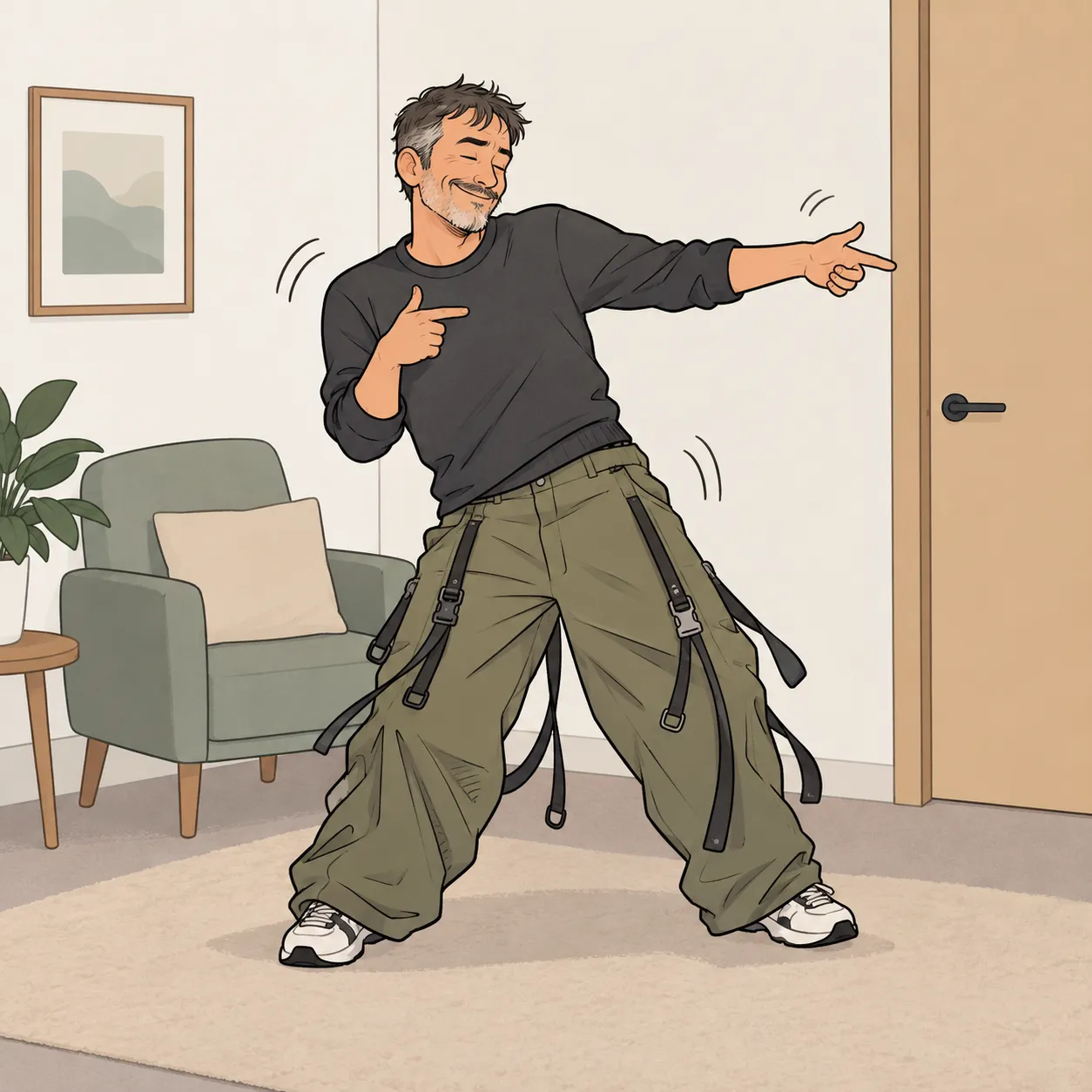
I walked into an appointment recently, said hello and immediately noticed the practitioner’s trousers. They were impossible not to notice: extremely baggy, made from that stretchy athleisure-type fabric, with straps hanging everywhere. Somewhere between dancewear, sportswear and ’90s boyband trousers. He looked like J.Lo’s backup dancer.
I looked at him, then at the trousers, and felt a tiny pause. A monitoring part was already checking the environment, the person and the possible consequences.
“I need to address those trousers.”
Apparently, they were “urban”. I told him I didn’t understand how he managed not to get caught on things and that the whole look was very ’90s boyband. He started singing “Bye, bye, bye…” and dancing. The trousers, it has to be said, had excellent movement.
He tried to encourage me to rap. I declined. I have occasionally attempted Lose Yourself, but today was not that day. There was already enough material.
As I left, I wished him good luck with his next album.
The part that checks afterwards
Then the monitoring part returned. I hope I didn’t hurt his feelings. That was a bit savage. It had checked whether it was safe to speak and now wanted to check what had happened because I had.
This wasn’t my first encounter with noteworthy trousers in a therapeutic relationship. A previous therapist wore tight trousers that left his ankles exposed. And his ankles were just… there, an unexpectedly prominent feature of the room. Eventually, I told him I kept noticing them. He explained that he wore his trousers that way because it kept him cooler.
Tight trousers, but release the ankles. I didn’t question the thermodynamics.
I remember having several possible responses and thinking, Don’t say anything that could get you into trouble. So I didn’t. I noticed something, anticipated a possible reaction and removed my response before it could become part of the interaction.
And that contrast interests me now. Sometimes I would lob something playful into the room and he would respond in a very practical way. He wasn’t rejecting me, exactly, but he wasn’t lobbing the ball back either. The energy just stopped there.
That was relational information too.
What gets edited out?
On the surface, this is ridiculous. Two men. Two pairs of trousers. Far too much consideration on my part. But there is something underneath it. I have been told that my easy, quiet temperament can lull people into a certain expectation of me. And then, occasionally, bam.
There has always been a quiet part of me. She observes, notices and takes in a great deal. Some of that is simply me. I’m an introvert. I don’t need to fill every silence.
But I’m becoming more interested in the moment before the silence. Was there actually nothing I wanted to say, or did something arise and get edited out before anyone else knew it was there? Those can look exactly the same from the outside.
Humour makes this especially obvious because there is always a small relational risk. I don’t know exactly how something will land until I let it out. I can’t fully control whether the other person finds it funny, rude, strange or unexpectedly revealing.
Maybe that is the experiment: how much of me can exist here? What happens if I say the slightly cheeky thing? Does the other person stay with me? Can we laugh? Can I be playful and still be taken seriously?
It is a little like lobbing a ball over to someone. Maybe they throw it back. Maybe they catch it and put it down. Maybe they miss it. Either way, I learn something about what is possible between us.
Monitoring wants that information in advance. Work out whether they’ll catch it before you throw it. But if I never lob the ball, I never find out.
More than being allowed to speak
Being less edited doesn’t mean saying everything I think. Nobody needs that. It means having more choice: noticing what has arisen and deciding whether I actually want to let it into the room, rather than automatically assuming I shouldn’t.
The monitoring part can still say, Don’t. Sometimes I’ll agree. Sometimes I won’t. It has often been an intelligent way of navigating relationships. I just don’t want it making every decision before the rest of me has arrived.
The baggy trousers happened to be one of those moments when the ball came flying back. If I had filtered out the comment, I wouldn’t just have lost one joke. I would have lost the singing, the dancing, the failed attempt to make me rap and the ridiculous little interaction that followed.
Sometimes the other person won’t lob the ball back. That tells me something too. But sometimes they will.
And sometimes, if a man’s trousers really do need to be addressed, you have to lob the ball to find out.